 By
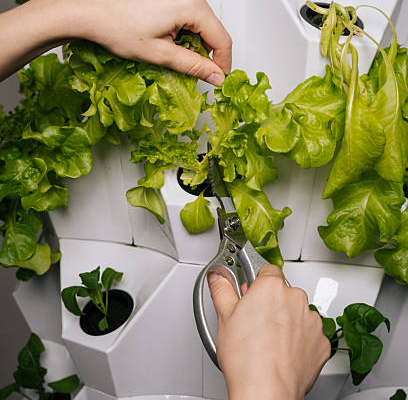
Honestly, the first time most people see an aeroponic tower, they assume the plants are floating on nothing. The roots hang in open air, leafy greens push out through the sides, and there isn’t a scrap of soil anywhere. It does look a bit like science fiction, which is part of the appeal for newcomers. But the thinking behind an aeroponic tower garden is surprisingly simple, and researchers have been testing it for more than a hundred years. Here’s the thing: once you understand how the system works, you can decide pretty quickly whether it deserves a spot in your home.
What Is an Aeroponic Tower Garden?
An aeroponic tower garden is a vertical growing system in which plant roots hang in the air inside a column while a mix of water and nutrients reaches them on a regular schedule. A pump at the base lifts the solution to the top of the tower, and gravity carries it back down over the roots, much like a small fountain. Whatever the plants don’t absorb drains into the reservoir and goes around again, so very little is wasted.
Because the roots are never submerged, they take in far more oxygen than roots buried in soil or sitting in a flooded tray. That extra oxygen is a big reason plants in an aeroponic tower grow so quickly. Some studies have measured growth up to three times faster than conventional soil gardening, although your own results will depend on the crop, the light, and how carefully you look after the system.
Aeroponics vs Hydroponics: Same Family, Different Style
People mix these two terms up all the time, so it helps to clear up the difference before going any further. Aeroponics is a type of hydroponics, not a competitor to it. Hydroponics is the broad category of growing plants in nutrient-rich water instead of soil, and it includes deep water culture, ebb and flow, and nutrient film technique. Think of sedans, pickup trucks, and SUVs, which look quite different from one another but are all still cars.
What sets aeroponics apart is that the roots are misted or dripped on rather than flooded. Other hydroponic methods keep roots sitting in water, while an aeroponic tower leaves them suspended in air, so they spend more of their time breathing than soaking.
A Short History That Might Surprise You
Aeroponics sounds like a recent invention, but its roots go back to 1911, when Russian botanist V.M. Artsikhovski sprayed nutrients into the air around plants to see whether they could absorb them that way, and they could. In 1957, Dutch biologist Fritz Went grew coffee plants and tomatoes with their roots hanging in air, sprayed nutrients directly onto those roots, and gave the technique the name we still use today.
The first commercial step came in 1983, when American Richard Stoner filed a patent for his Genesis Rooting System. His follow-up design was a closed loop with a nutrient recycling reservoir, and that same principle still drives modern towers. NASA joined the story in 1997, running aeroponic tests on the Mir space station with adzuki beans. The seedlings grown in space actually grew faster than the ones grown on Earth.
Benefits of Growing in an Aeroponic Tower
Speed gets most of the attention, but it’s far from the only advantage, and several of the others are what tend to win people over in the long run.
- Faster growth. Roots get plenty of oxygen and nutrients arrive directly, so the plant spends its energy growing upward instead of searching for food underground.
- Serious water savings. The closed loop recycles water continuously, which adds up to roughly 95 percent less water than traditional gardening, where most of it is lost to runoff and evaporation.
- A tiny footprint. In less than one square meter you can grow 24 pots of herbs and vegetables, a harvest that would otherwise need several meters of garden bed.
- Less mess and fewer problems. With no soil, you can bring the garden indoors without the dirt, and suspending roots in air virtually eliminates root rot, which usually comes from overwatering or poor drainage.
- Precise nutrient control. It’s easier to fine tune what your plants receive, and the system needs less fertilizer overall.
How an Aeroponic Tower Works Day to Day
A typical aeroponic tower is a stack of lightweight, food grade plastic sections, each holding planting pockets, with a reservoir at the bottom. Four parts do most of the work. The reservoir holds the nutrient solution, and a larger one means less frequent refilling. The pump pushes that solution up the tower, and a quiet submersible pump is the usual choice for home systems. LED grow lights cover the full height of the tower if you’re growing indoors without a sunny south facing window. Timers tie it all together by running the watering and lighting cycles automatically.
Maintenance is considerably less demanding than it sounds, and most of it comes down to a few weekly checks. Check the pH once a week and aim for a range of 5.5 to 6.5, because plants can’t absorb nutrients properly outside it, and keep the pump fully submerged. A good starting watering schedule is 15 minutes on and 45 minutes off for 14 to 18 hours a day indoors, with more frequent watering as temperatures rise. If you use LEDs, run them 12 to 16 hours daily and keep them 6 to 10 inches from the plant canopy. Most plants are happiest between 65 and 78 degrees Fahrenheit with humidity around 60 percent.
What Can You Grow in an Aeroponic Tower Garden?
Quite a lot, as it turns out, considering how little space the system occupies. Leafy greens such as lettuce, kale, spinach, and mustard greens are the most reliable performers, and herbs like basil, parsley, dill, and thyme do really well too. Tomatoes, cucumbers, peppers, and strawberries are possible as well, though vining crops like tomatoes and cucumbers need a trellis for support. The one group to skip is root vegetables. Carrots, potatoes, and onions grow downward and simply don’t have the room inside the tower.
Who Is an Aeroponic Tower Best For?
Apartment dwellers and anyone without a yard are the obvious fit, since a tower works on a balcony or in a spare corner indoors. Busy people like it because timers handle most of the routine, so you don’t need gardening experience to get started. It also makes sense in arid regions, where water is scarce and recycling it matters, and it’s a popular teaching tool for schools. And if you simply want to know exactly how your food was grown, with no pesticides or herbicides, growing at home gives you that control from seed to harvest.
Final Thoughts
An aeroponic tower won’t replace every garden bed, and it doesn’t need to. What it does well is deliver fast, clean, space efficient harvests with very little water. If you’re curious about what a complete setup looks like, you can explore a full aeroponic tower from ALTO Garden to see the components, sizes, and growing options in one place. Start with a few lettuces and herbs, get comfortable with the timers and pH checks, and you’ll probably be planning your next tower before the first harvest is done.


Comments